
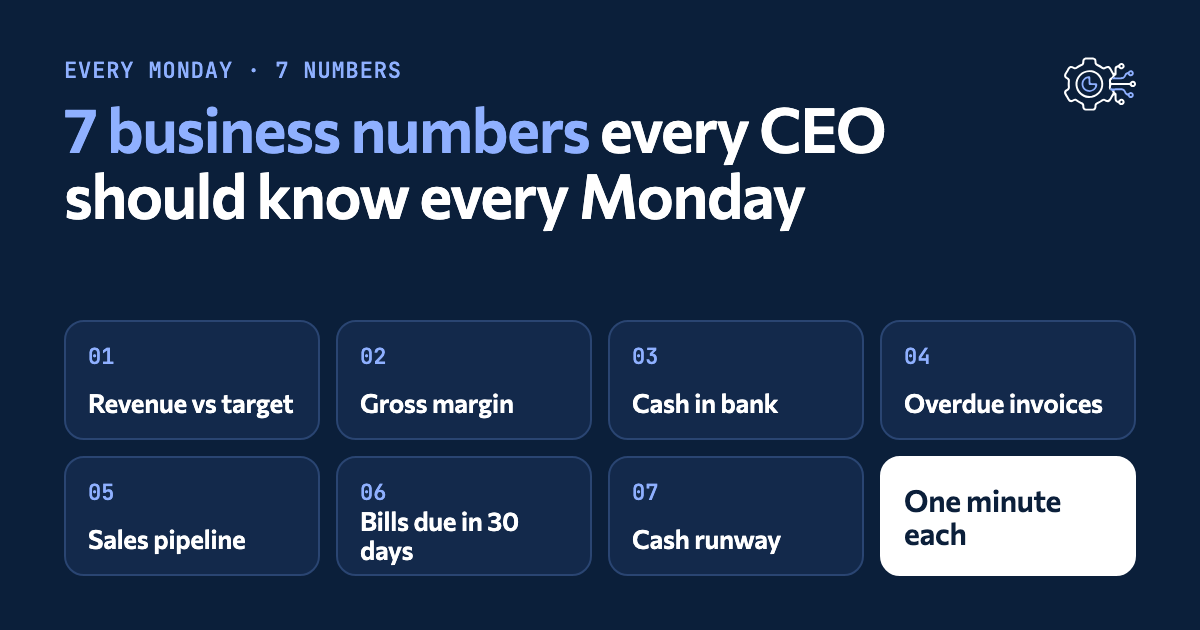
You do not need 40 KPIs to run a company well. You need a few numbers, the same ones, at the same time every week.
Here are seven. Together they answer the questions a CEO asks on a Monday morning: Are we on plan? Do we make money on what we sell? Can we pay what we owe? What is coming next?
Each one below has a plain definition, how it is calculated, the question to ask, and the most common trap.
1. Revenue vs target
What it is: what you have sold so far this period, against what you planned.
How to calculate it: revenue so far ÷ target for the period. Say which revenue you mean: booked, invoiced or collected. Pick one and keep it. (We wrote about why this matters in Why your departments report different numbers.)
Ask: Are we ahead or behind plan?
Trap: comparing this week’s invoiced revenue with a target set in booked revenue. The gap looks like a problem and is only a definition.
2. Gross margin
What it is: what is left of each euro of sales after the direct costs of delivering it.
How to calculate it: (revenue − direct costs) ÷ revenue.
Ask: Do we still make money on what we sell?
Trap: revenue goes up and margin quietly goes down. If you only watch revenue, you will not see it until the cash runs short. Check that all direct costs are included, such as subcontractors and supplier costs.
3. Cash in bank
What it is: the money you can spend today.
How to calculate it: the balance of your bank accounts, using cleared funds only.
Ask: Can we cover this month?
Trap: treating profit as cash. A profitable month can still end with an empty account if customers pay late. Cash in bank is the one number that does not care about your accounting.
4. Overdue invoices
What it is: money customers owe you past the due date.
How to calculate it: the total of unpaid invoices past their due date. Split it by age: 1–30 days, 31–60 days, over 60 days.
Ask: Who do we call this week?
Trap: looking only at the total. A large amount that is 5 days late is a reminder. A smaller amount that is 90 days late is a risk. The age split tells you which is which. This is the one number in the set we would mark in amber.
5. Sales pipeline
What it is: open deals and their total value, by stage.
How to calculate it: the sum of open deal values, grouped by stage. Optionally weight each stage by how often deals at that stage have closed for you in the past.
Ask: Is there enough in the pipeline for next quarter?
Trap: old deals that are never closed or dropped. They make the pipeline look healthy. A simple rule helps: a deal counts only if it has a next step with a date.
6. Bills due in the next 30 days
What it is: what you have to pay out over the next month.
How to calculate it: all supplier bills, payroll, loan payments, taxes and VAT with a due date in the next 30 days.
Ask: Will our cash cover them?
Trap: counting only supplier bills. Payroll, tax and VAT are the payments most often forgotten, and they are the ones you cannot delay.
7. Cash runway
What it is: how many months you can keep running on the cash you have, at your current level of spending.
How to calculate it: cash in bank ÷ average monthly cash going out. If cash is coming in, use the net: average monthly cash out minus average monthly cash in.
Ask: How many months do we have?
Trap: using your best month as the average. Use the last three to six months, so one unusual month does not decide the answer.
The Monday check, in one table
| # | Number | Question |
|---|---|---|
| 1 | Revenue vs target | Are we ahead or behind plan? |
| 2 | Gross margin | Do we still make money on what we sell? |
| 3 | Cash in bank | Can we cover this month? |
| 4 | Overdue invoices | Who do we call this week? |
| 5 | Sales pipeline | Is there enough for next quarter? |
| 6 | Bills due in 30 days | Will our cash cover them? |
| 7 | Cash runway | How many months do we have? |
Make it a habit, not a project
Knowing the seven numbers is the easy part. Checking them every week is where most teams stop. Three things help:
- Same numbers, same order, same day. After a few weeks you read them in a minute and notice what changed.
- One owner per number. When a number looks wrong, one person answers. Finance usually owns 1 to 4 and 6 to 7. Sales owns 5.
- Send them to you. If you have to open a spreadsheet and ask someone to refresh it, you will skip it on busy weeks. A KPI email that arrives on Monday morning does not depend on anyone remembering.
Next step
If getting these seven numbers takes your team hours, or the numbers differ between departments, we can help. We connect your accounting, CRM and spreadsheets, agree one definition per number, and send you a KPI email every Monday. See how on our executive dashboards page.